In the food, chemical, wood, and animal feed industries, the risk of dust and gas explosions is an inherent part of many technological processes. Despite implementing measures to prevent the formation of explosive atmospheres and eliminate potential ignition sources, it is not always possible to completely eliminate the risk of an explosion. For this reason, modern process safety practices also include systems designed to mitigate the effects of explosions. One of the most commonly used solutions is explosion venting, which is designed to release overpressure and flames from protected equipment in a controlled manner.
How does explosion venting work?
During an explosion inside an enclosed process vessel, the pressure rises extremely rapidly. If it exceeds the structural strength of the equipment, it may cause deformation, rupture, damage to adjacent installations, and ultimately pose a direct threat to personnel. The purpose of an explosion venting system is to limit this pressure to a level that does not exceed the pressure resistance of the protected equipment. As a result, the explosion energy is safely vented to the outside, while the equipment itself remains intact or sustains only minor deformation.
The effectiveness of the entire solution depends on the correct sizing of the vent area, the explosive characteristics of the product, and the mechanical strength of the equipment. Designing such systems is therefore not simply a matter of installing an explosion vent panel, but requires a detailed analysis of the entire technological process.
Venting panels – a simple and highly effective solution
The most common components of venting systems are explosion vent panels, also referred to as explosion relief panels. Under normal operating conditions, they remain fully sealed; however, as soon as a specified overpressure is reached, their membrane opens, allowing gases and explosion products to be discharged immediately into the surrounding environment. This process takes only fractions of a second, effectively limiting the pressure developing inside the equipment.
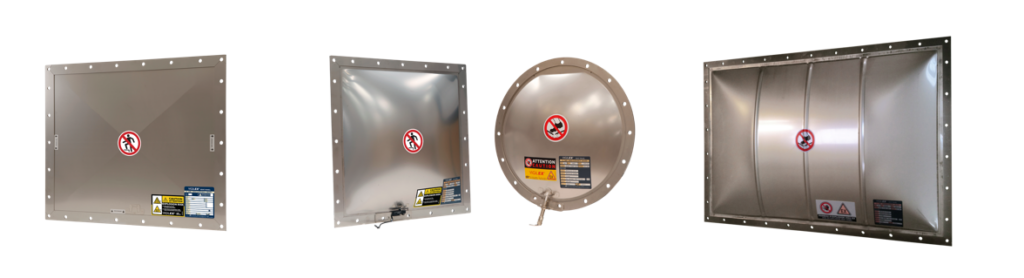
The advantage of explosion vent panels is their relatively simple design and their versatility across a wide range of process equipment. They are used on equipment such as silos, dust collectors, cyclones, separators, and dryers. Due to their relatively low investment cost, they are one of the most frequently selected methods of explosion protection.

Explosion venting is about more than just pressure
Although vent panels effectively protect equipment from destruction, it is important to remember that when they open, much more than just overpressure is released into the surroundings. Flames, hot gases, and unburned particles of the process material are also ejected. In practice, this creates a hazardous zone that may extend up to several dozen metres, depending on the volume of the protected vessel and the explosive characteristics of the material. Therefore, when designing a venting system, it is necessary to consider not only the selection of the vent panel itself, but also the proper designation of safety zones around the equipment.
This aspect is often overlooked when older installations are modernised. A properly functioning vent panel does not eliminate the effects of an explosion; it merely directs them outside the protected equipment in a controlled manner.
When should a deflector be used?

Not every installation allows flames to be safely discharged vertically upwards. In many industrial plants, equipment is located close together and is surrounded by walkways or other technological infrastructure. In such cases, conventional venting may prove insufficient.
The solution is to use deflectors mounted directly on the explosion vent panels. Their purpose is to direct the flame and explosion products towards a safer area while reducing the hazardous zone. As a result, vent panels can also be used in locations where installation space is limited or where obstacles prevent the unobstructed discharge of explosion products.

Most common design errors
Explosion venting is a highly effective solution, but only when it is designed correctly. One of the most serious mistakes is installing vent panels inside enclosed rooms without implementing additional protective measures. It is equally dangerous to direct the vent discharge towards other equipment, buildings, or walkways. Problems may also arise from incorrect positioning of the panels on the vessel, which can generate additional forces acting on the structure during an explosion. Particular caution must also be exercised in processes involving toxic or corrosive substances, as conventional venting releases them into the surrounding environment.
Flameless explosion venting – a solution for indoor installations
In situations where conventional venting cannot be used, flameless explosion venting systems are employed. They combine an explosion vent panel with a highly efficient flame-quenching element that retains the flame and a significant portion of the combustion products while allowing the explosion pressure to be safely released. This solution enables equipment operating inside production halls to be protected without the risk of releasing flames into the surrounding area.
Summary
Explosion venting is one of the most widely used methods of explosion protection in industry. A properly designed system effectively limits explosion pressure and protects equipment from destruction. However, it should be remembered that this is not a universal solution – the selection of the appropriate protection method always depends on the specific characteristics of the technological process, the properties of the substance, and the operating conditions of the installation.
In the next article, we will examine other explosion mitigation methods, such as explosion suppression and explosion isolation. We will explain when they should be used, how they differ from explosion venting, and why combining multiple protection systems provides the best results in many installations.
Consult our specialist and request additional materials – Contact
Your feedback helps us improve the knowledge base.
Related articles


