Sebastian Słaboszewski

s08

From Methane Hazards to Explosion Hazard Assessment: The Evolution of Poland’s Explosion Protection System

Origins of Polish explosion protection An explosion is one of the most dynamic phenomena encountered in industry. Regardless of whether it occurs in an underground mine working, a grain silo, a chemical plant, or a production hall, its course is governed by the same laws of physics. The type of fuel, spatial geometry, and process

From Methane Hazards to Explosion Hazard Assessment: The Evolution of Poland’s Explosion Protection System Dowiedz się więcej »

35

From Explosion Scenario to Structural Action Model – Designing Industrial Buildings at Risk of Explosion

Why Analysis Begins Before Calculations In design practice, a significant source of errors in explosion protection is often not the calculation procedure itself, but an incorrectly defined event scenario that the procedure is intended to describe. This is particularly relevant to industrial facilities where the explosion hazard results from a combination of the technological process,

From Explosion Scenario to Structural Action Model – Designing Industrial Buildings at Risk of Explosion Dowiedz się więcej »

r01

Fire and Explosion Hazards of Bucket Elevators

In many industrial facilities, bucket elevators are among the primary types of mechanical conveying equipment and often operate continuously around the clock. From a fire and explosion safety perspective, however, they require particular attention. Despite their relatively simple design, they can present significant fire and explosion hazards, although in practice they are not always regarded

Fire and Explosion Hazards of Bucket Elevators Dowiedz się więcej »

Flameless explosion venting – when should it be used instead of explosion vent panels?

In one of our previous articles, we discussed conventional explosion venting using explosion vent panels. It is one of the fundamental methods of protecting process equipment against the effects of dust and gas explosions, widely used in the food, wood, chemical, and pharmaceutical industries, among others. The operating principle is relatively simple – when a

Flameless explosion venting – when should it be used instead of explosion vent panels? Dowiedz się więcej »

obr10

Explosion venting – a fundamental method of protecting process equipment against the effects of explosions

In the food, chemical, wood, and animal feed industries, the risk of dust and gas explosions is an inherent part of many technological processes. Despite implementing measures to prevent the formation of explosive atmospheres and eliminate potential ignition sources, it is not always possible to completely eliminate the risk of an explosion. For this reason,

Explosion venting – a fundamental method of protecting process equipment against the effects of explosions Dowiedz się więcej »

gra05

Combustible Dusts – An Invisible Hazard in Industry

Combustible dust is present in many industrial processes, often without attracting much attention during everyday operation. It can be generated during grinding, screening, drying, conveying, or storing bulk materials and is commonly encountered in the food, wood, chemical, pharmaceutical, and metal-processing industries. Although it may appear harmless at first glance, under the right conditions it

Combustible Dusts – An Invisible Hazard in Industry Dowiedz się więcej »

1764976902212

What Did a Disaster Costing Over $345 Million Teach Us About Risk?

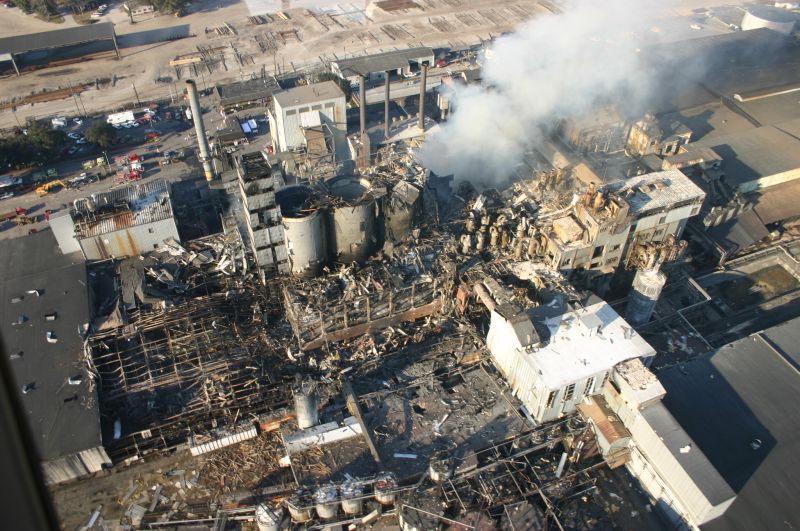
On February 7, 2008, a catastrophic explosion occurred at the Imperial Sugar refinery in Port Wentworth, Georgia. Fourteen workers were killed, 36 sustained serious injuries, and one of the largest sugar-processing facilities in the United States was effectively destroyed within seconds. What initially appeared to be a sudden and tragic industrial accident was, in reality,

What Did a Disaster Costing Over $345 Million Teach Us About Risk? Dowiedz się więcej »

q03

Effects of an Explosion – Why Do Secondary Effects Cause the Most Severe Consequences?

The greatest hazard often arises after the explosion An explosion is primarily associated with a sudden pressure wave and flame propagation, affecting people, equipment and structures within a fraction of a second. These are the most visually dramatic aspects of such an event and therefore tend to dominate media coverage of industrial accidents. From a

Effects of an Explosion – Why Do Secondary Effects Cause the Most Severe Consequences? Dowiedz się więcej »

rys2

Does Abrasive Blasting of Metals Pose a Real Explosion Hazard?

This question repeatedly arises in the context of explosion safety during abrasive blasting of metals. This article encourages contributions from practitioners and specialists in risk assessment and risk management, including those from the insurance sector, to enrich the analysis with their knowledge and experience. To begin, it is worth clarifying what metal abrasive blasting is.

Does Abrasive Blasting of Metals Pose a Real Explosion Hazard? Dowiedz się więcej »

obraz

A new approach to explosion safety: prEN 16447:2025 as a response to contemporary industrial challenges

Explosion safety in facilities processing bulk materials is becoming one of the most significant areas of operational risk. The increasing scale and complexity of pneumatic conveying systems and dust collection installations raise the likelihood of forming explosive atmospheres and the propagation of explosions through ductwork. A central element of protective systems remains explosion isolation flap

A new approach to explosion safety: prEN 16447:2025 as a response to contemporary industrial challenges Dowiedz się więcej »